

When an account or initiative starts to slip, most leaders make the same move. They zoom out. They question the strategy. They look at tools. They start talking about transformation.
It’s not entirely wrong. Actually, this can be positive in some instances. But it’s not always where the problem lives.
Because while that conversation is happening, the real signals are already showing up in plain sight:
- Stakeholders are going quiet
- Internal teams are disengaging
- Usage is inconsistent
- And no one can clearly point to recent value
At that point, this isn’t a systems problem. You have a confidence problem. And if you don’t address it quickly, it turns into churn risk, stalled expansion, or worse, a slow, polite disengagement that no one escalates until it’s too late.
The fastest way to regain control isn’t a new roadmap. It’s making value undeniable, immediately. Once teams can see progress again, even in a narrow slice of the business, something shifts. Energy returns. People re-engage with the system, the goals, and each other. And that renewed engagement is what creates the conditions for expansion, not just recovery.
Restore Confidence by Showing Value Fast
When momentum starts to slip, the objective becomes very simple: make value visible, now. This isn’t about pushing the full roadmap forward, at least not yet. It’s about stabilizing the situation and re-anchoring the initiative in something tangible. The system has to feel useful again. The relationship has to feel productive again. That means identifying something real you can improve, unlock, or simplify within days or weeks, not quarters.
We see this play out repeatedly. One organization had spent over a year working toward a major implementation. On paper, everything was progressing. In reality, momentum had stalled. Instead of forcing the broader rollout, the team narrowed in on a few core workflows and made them work, quickly. Within weeks, the system started delivering again. Teams returned to tools they had quietly abandoned. Confidence came back, not because of the plan, but because something finally worked. That shift is what reopened the path to adoption.
In another case, a team had a large portion of their capacity tied up in repetitive, low-value tasks. No one had paused to challenge it, it had just become “how things work.” A targeted intervention removed a significant portion of that effort within weeks. The impact was immediate. Time was freed up. Visibility improved. And just as importantly, belief in the system’s usefulness returned.
These aren’t transformational programs. They’re not meant to be. They’re targeted interventions in places where value already exists, but hasn’t been realized or made visible.
And when done right, the pattern becomes predictable:

Once confidence is restored, everything else becomes easier. Teams are more open. Stakeholders are more engaged. The system has another shot.
Stabilization isn’t separate from growth. It’s what makes growth possible.
Early Wins Create the Foundation for Growth
Once trust is rebuilt, broader initiatives become possible; but expansion is earned, not assumed. Teams are more open to new workflows and advanced tools when they have already seen tangible results.
Phased adoption is key. The leaders who recover accounts consistently follow a pattern, whether they realize it or not:
- Diagnose where confidence broke (not just where process broke)
Ask:
- Where has usage dropped off?
- Where are teams working around the system?
- Where are stakeholders no longer seeing outcomes?
This is less about dashboards, more about behaviour.
- Isolate a high-impact, low-friction win
Not a full rollout. Not a multi-phase plan. One thing that:
- Frees up time
- Improves visibility
- Or removes daily frustration
- Deliver it fast and make it obvious
This is where most teams fail. If the improvement isn’t visible, it doesn’t count.
- Call it out
- Show before/after
- Bring it into leadership conversations
- Use that win to reset the narrative
Once value is visible again:
- Re-engage your champion
- Reconnect with exec stakeholders
- Reposition the initiative as “back on track”
Leaders start with core modules or automations, observe measurable gains, and then layer on advanced capabilities. This ensures the organization can absorb change without losing momentum, while also creating proof points for future investments in optimization and broader process adoption.
Early wins also provide clarity. They reveal where workflows are effective and where gaps remain, helping leaders prioritize the next initiatives. The pattern is consistent: stabilize teams and systems first, then expand with confidence.
Expand Scope Once Trust Is Earned
Once a team sees something work again, a few things shift quickly:
- Skepticism softens
- Adoption increases
- Stakeholders become more responsive
Now you can start introducing broader changes, because the organization has evidence that change leads to outcomes. And when you do, it should feel like a natural next step, not a forced sell.
What expansion looks like after recovery:
- Introducing adjacent workflows once core usage is stable
- Expanding into new teams with a proven use case
- Layering in automation or reporting once data is trusted again
At this point, your conversations change. You’re no longer defending value; you’re building on it.
The progression is intentional:
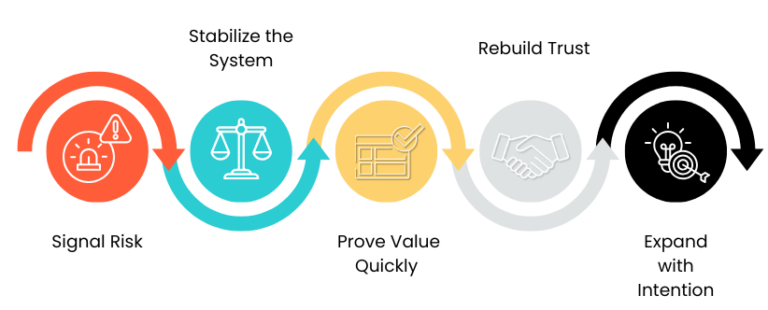
Leaders gain visibility into both system performance and team engagement, providing a clear roadmap for scaling initiatives without creating resistance.
Momentum from quick wins carries the organization from stabilization to transformation, turning previously stalled initiatives into engines of growth.
Why Quick Wins Compound Into Strategic Opportunity
Quick wins don’t just fix isolated issues. They reset the trajectory of an account or initiative. What they actually restore isn’t just performance, it’s belief, in the system, in the initiative, and in the people driving it forward.
And once that belief returns, behaviour follows.
Teams start using the system again, not because they’re told to, but because it works. They save time. They trust the data. Friction drops. Re-engagement becomes real, not forced. That’s when early wins begin to compound.
They become proof points, not just progress markers. Proof that the investment was right. Proof that change is working. Proof that there’s more upside ahead. That proof is what turns a stalled initiative into a growth conversation, aligning stakeholders, rebuilding internal credibility, and creating clarity around what’s actually possible when systems and workflows start working together again.
When progress starts to stall, the fastest path back isn’t more planning. It’s visible results.
And here’s the part most leaders hesitate to acknowledge. By the time something looks off track, it’s already been slipping for a while. So the question isn’t whether to act, it’s how quickly you can create a meaningful shift in the next two to three weeks. That window matters.
If you’re leading a sales organization, managing strategic accounts, or owning a critical initiative, the play is straightforward. Find what’s already valuable but underused, simplify it until it’s easy to adopt, ship improvement quickly, and make the impact visible to the right stakeholders. Then repeat the cycle.
That’s how you move something out of the red, not by resetting the strategy, but by restoring momentum. And momentum is what creates the space for expansion.
The real question isn’t whether quick wins are possible. It’s whether you’re willing to act decisively enough to create them, and use that early value to unlock something bigger. Because the leaders who do this well don’t just stabilize accounts, they turn them into growth opportunities.
If you want to explore how to stabilize initiatives quickly and build toward larger opportunities, let’s chat.