

Revenue teams are rarely short on data; they are short on a shared understanding of what it actually means and what to do next.
Dashboards tend to multiply as companies scale, but clarity across the revenue engine doesn’t scale with them. In fact, the more the system is used by revenue functions such as Sales, Marketing, Service, and Finance, the more its inconsistencies show if not designed intentionally for alignment. Leaders are left reconciling competing versions of the funnel, debating forecast inputs, and making high-stakes investment decisions without a shared understanding of how revenue actually flows.
Foursight by Lane Four was created to solve that problem.
At its core, Foursight offers a comprehensive revenue assessment designed to give leaders visibility above the treeline—a clear, reconciled view of how people, process, data, and technology work together to produce revenue outcomes. The assessment delivers a clear, end-to-end view of the revenue engine, enabling teams to design intentionally for scale and address the structural barriers constraining growth.
Why Revenue Engines Fail Quietly
Revenue engines seldom collapse outright, but instead lose effectiveness as multi-department complexity outpaces both system design and cross-functional alignment.
As organizations layer in new products, regions, pricing models, and tools, the revenue engine becomes increasingly difficult to govern, especially without RevOps leadership oversight to maintain alignment. Teams compensate locally to maintain momentum, but those workarounds compound into systemic misalignment over time. What looks like a performance issue is often a failure of system design.
Foursight treats revenue execution as a designed system, not a collection of functional outputs.
What the Foursight Assessment Actually Evaluates
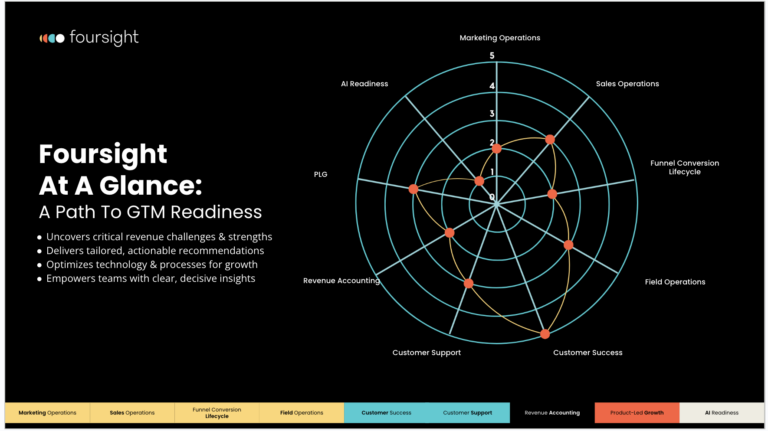
The Foursight RevOps Assessment examines the revenue engine end-to-end across:
- People (roles, accountability, operating cadence)
- Process (funnel design, handoffs, qualification, forecasting logic)
- Technology (CRM architecture, tooling sprawl, automation)
- Data (definitions, metrics, reporting logic, trust)
Specifically, the assessment spans: core revenue lifecycle areas, targeted operational elements, and over 200 diagnostic questions, tailored to the company’s growth stage, go-to-market complexity, and future goals.
This depth allows Foursight to surface not just isolated gaps, but how those gaps interact; creating blind spots, forecast risk, and decision friction at scale.
Importantly, Foursight does not deliver a generic maturity score. Leaders receive a prioritized, executable roadmap tied directly to business outcomes: pipeline visibility, forecast confidence, and scalable decision-making.
What “System-Level Insight” Looks Like in Practice
System-level issues rarely live inside a single team. They surface when leadership asks cross-functional questions and the answers do not reconcile.
This is especially common in portfolio and post-M&A environments.
In one portfolio-level engagement across five operating companies, each business had its own:
- Sales motions
- Funnel definitions
- CRM configurations
- Reporting logic
Individually, teams were performing. Collectively, leadership lacked a consistent view of pipeline health or forecast risk. Underperformance was identified too late to correct, and board confidence suffered.
Through executive interviews, CRM analysis, and reporting audits, Foursight mapped how revenue actually moved across each company. The assessment revealed where misaligned processes, inconsistent metrics, and fragmented tooling compounded into systemic risk.
The outcome:
- A normalized KPI and funnel framework across companies
- Shared dashboards aligned to leadership decision cadence
- A governance layer to ensure consistency and accountability
The result was not just better reporting, but earlier detection of underperformance, faster intervention, consistent pipeline visibility, and restored trust in the data guiding strategic decisions.
This is the difference between tracking revenue and managing it as a system.
The Real Value of Foursight
For revenue leaders, the value of Foursight is practical:
- Defensible pipeline and forecast logic
- Clear operating discipline across functions
- Confidence that the revenue system can support the next phase of growth
Foursight gives leadership a shared language for revenue, a clear view of risk, and a concrete plan to move forward with intent. If you are preparing for your next phase of scale, building a case for investment, or bringing discipline to an increasingly complex go-to-market motion, the real question is not whether better revenue operations would help. The question is whether you can afford to continue operating without them. Curious what your revenue system is really telling you? Let’s chat.