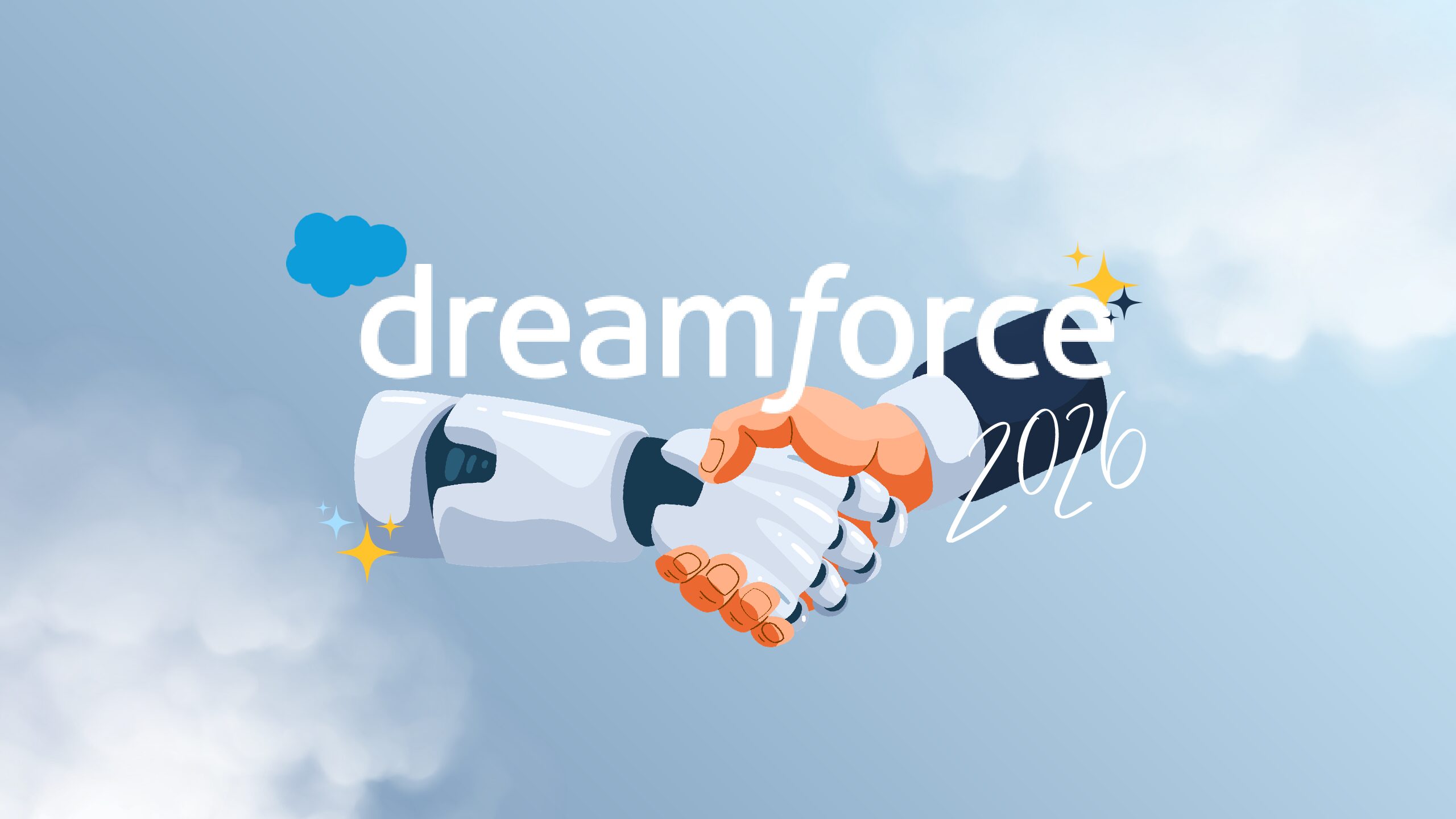
TL;DR | The Highlights
- Look at Salesforce’s own two lines for Dreamforce 2026. One is agent-forward (the agentic enterprise, Agentforce, Agentforce 360). The other is human-first: powered by you, amplified by agents. That tension is the story.
- Two years in, the market’s hesitation about agents was never really about capability. It was about trust, control, and accountability.
- The tell is already in the room: an agentic conference headlined by a researcher who studies trust in AI and a run of human-centered voices, not just technical demos.
- Read the human-first tagline as Salesforce catching up to the objection buyers already had, not a capability victory lap.
- If you’re evaluating Agentforce, the question was never “can it do the task.” It’s “who’s accountable when it does.”
We’re putting a read on the record before Marc Benioff takes the opening keynote stage. And this time, the evidence is already sitting on Salesforce’s own pages.
Salesforce has given Dreamforce 2026 two lines, and they don’t quite say the same thing. One is agent-forward: the theme is becoming an agentic enterprise, and the messaging leans hard on Agentforce and Agentforce 360; the agents built to take real action across your business. The other puts the human first: powered by you, amplified by agents. Read them side by side and you can watch the emphasis slide off the machine and onto the person operating it.
That’s the story. Not a tagline swap, because both lines are live at once. The tell is that the human-first line is there at all, and we think Salesforce leans on it harder than the pure capability pitch. We’re calling it now.
The Tension Is Sitting in Salesforce’s Own Words
Look at what Salesforce is actually saying about this year, and notice it’s saying two things at once.
One pole is all about the agent: “Becoming an agentic enterprise”. Agentforce, the tooling to build AI agents and put them to work on real workflows. Read only that, and the message is simple: the agents are ready. And it seems the way Salesforce has been making this front and center since 2024 suggests it’s been this way for a couple years now.
But now read the line they pair it with: “Powered by you, amplified by agents”. That one doesn’t lead with the agent at all. It leads with you, and casts the agent as the thing that extends your reach. Same event, same company, two different centres of gravity.
We don’t think that’s an accident and we don’t think it’s just a nice copy. Salesforce even describes the main keynote itself as being about humans, agents, and platforms working together, not agents running the show alone (like they’ve positioned it previously). When a company spends two years making the agent the hero, then hands the lead role back to you, that’s worth reading closely. So here’s how we read it.
The Story Isn’t the Agents. It’s Who Salesforce Put On Stage With Them.
Start with the lineup because it points the same way the tagline does.
An agentic conference, and the headline stage includes a behavioural scientist who studies trust and human agency in AI decisions, next to actors and human-centered voices you wouldn’t expect at a technical keynote. That’s not who you book to say “our agents are more capable than ever.” That’s who you book to say “here’s how people and agents work together, and here’s why you can trust it.”
A company spends two years selling what its agents can do. Then it gives its biggest stage to the human relationship with those agents. That’s a signal, not a coincidence.
Did Salesforce Jump the Gun? Look at the Last Two Years.
It’s worth asking the blunt question. Did they get a little ahead of themselves?
Agentforce landed in 2024, bold and early: autonomous agents acting inside your systems. 2025 pushed it from a promising demo toward something teams could actually put to work. 2026 is framed around execution and scale, but look at what’s wrapped around the execution story this time. Trust. Oversight. Governance. The responsible way to deploy autonomous systems.
If this were purely a capability story, the messaging would be leaning harder into autonomy, not adding a powered by you (a human) on top of it. A year of real deployments in, the hesitation didn’t melt away under better demos. So what we’re watching looks less like a victory lap and more like a recalibration, a company bringing the human back to the centre after an experimentation period showed exactly why that matters.
We don’t say that to knock them. We say it because it’s an honest read, and because it lines up with something we’ve been telling clients all along.
The Objection Was Never Capability. It Was Accountability.
Here’s the part most of the agentic conversation gets backwards.
Nobody really doubted that an agent could draft the email, update the record, or route the case. Capability was never the sticking point. What made people hesitate was quieter and harder to answer. Who owns the outcome when the agent acts? Where does a human stay in the loop? What happens when it’s confidently wrong in a regulated filing, or right in front of a customer? Are we sure that permission on data are 100% set up correctly?
That’s not a capability gap. It’s a trust and control problem.
And this is where Salesforce’s own tagline stops being a nice line and starts being an operating principle. Powered by you, amplified by agents only works when there’s a clear you doing the operating, accountable for the outcome, with the agent extending your reach instead of replacing your judgement. Putting the human first is Salesforce meeting the objection where it actually lives.
We’ve Been Saying This the Whole Time, and We’re Glad the Alignment Is Here.
For a time, the industry seemed to quiet down on the “human-in-the-loop” conversation. It’s easy to see why: the market was captivated by the sheer capability of autonomous agents, and the industry raced to prove that the machines could do the work. The focus shifted, temporarily, to the agentic play as the primary demonstration of progress.
None of this is new to us.
We’ve told clients from the start that you can’t just turn these agents loose yet. You build in a permission floor, clear human accountability, and an audit trail before you scale anything. Not because the technology is weak, but because trust is earned through control, not assumed. An agent you can’t see, correct, or answer for isn’t ready for the work that matters most.
While the market may have let the “human-in-the-loop” buzz fade in favour of pure agent capability, accountability and trust haven’t changed. We remain transparent with our customers: successful AI deployment, in the long term, requires humans to remain part of the process.
So no, we don’t read Dreamforce 2026 as a gotcha. We read it as alignment. Our friends at Salesforce are putting humans first on the biggest stage in the ecosystem, and that’s exactly what we’ve been building toward with every client. It’s not a reason to gloat. It’s good news for everyone deploying this, because the whole market moves faster when the platform and the people implementing it are finally telling the same true story.
So Change the Question You’re Asking About Agentforce
If you’re heading to Dreamforce to size up Agentforce, here’s the practical shift.
Don’t lead with “can it do the task.” You already know the answer, and the demos will erase any doubt. Lead with the questions the demos won’t volunteer. Who’s accountable when the agent acts? Where’s the permission floor? Where does a human have to sign off before something ships? What’s the audit trail when something goes wrong?
The capability question is easy and mostly settled. The accountability question is the one that decides whether you can actually put this into production, whether that’s Agentforce or anything else. Ask it early, and ask it of every vendor on the floor.
Bringing It Back
Strip away the theme and the staging and here’s what we think Dreamforce 2026 is really about. Not (only) how capable the agents have gotten, but that the market’s real question around accountability, finally moved to the centre of the story. Powered by you, amplified by agents is Salesforce’s line. Reading it as the real headline, ahead of the capability story, is ours, and we called it before the keynote.
We’ll be there this year, and we’ve been having this conversation with clients since before it was the headline. Whether we already work together or you’re weighing your first agent rollout, come find us and say “hi”. Let’s chat.
Let's chat!