TL;DR | The Highlights
- Dreamforce 2026 delivered plenty of substance behind the Agentic Enterprise theme, from AIforce and Agentforce Coworker to a continued emphasis on trusted data, governance, and measurable ROI.
- But new capability is only one part of the equation. The more important question for businesses is how that technology fits into the systems, processes, people, and priorities they already have.
- That’s where Dreamforce becomes particularly valuable. For three days, customers, Salesforce teams, partners, architects, operators, and technology leaders bring very different perspectives on the same ecosystem into one place.
- Those perspectives matter because no single seat sees the whole picture. Product teams know what’s possible. Customers know what’s practical. Sellers know what businesses are asking for. Architects and partners see what it takes to connect those pieces in the real world.
- At Lane Four, that cross-ecosystem perspective is a big part of how we build our own point of view. We don’t form recommendations around one product announcement or one implementation. We look for the patterns that repeat across conversations, customers, industries, and architectures.
- And increasingly, that’s where we believe good consulting creates value: not simply knowing what’s new, but understanding where it matters, for whom, and what needs to be true for it to actually work.
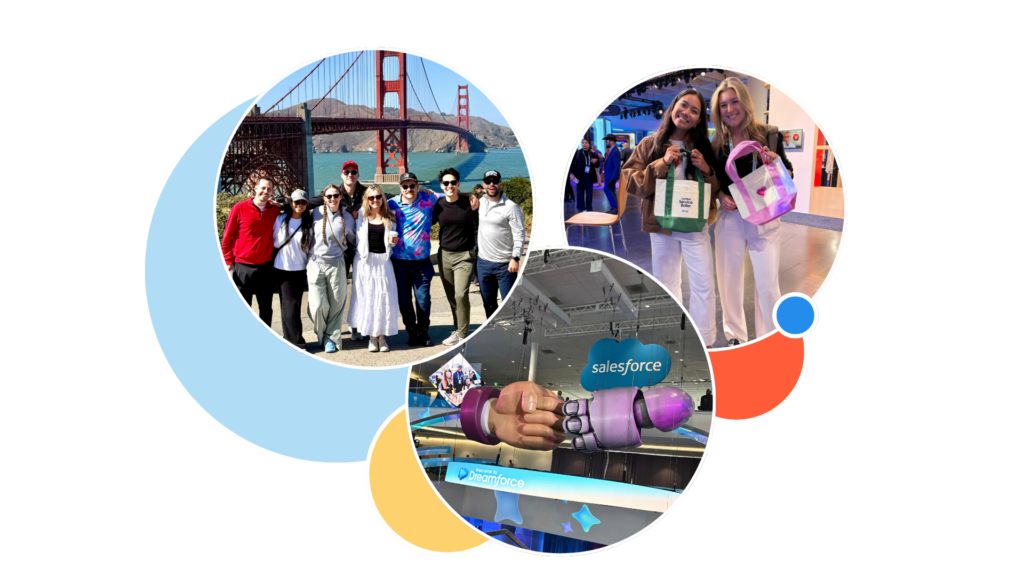
Our team spent the past week at Dreamforce 2026 in San Francisco, where, unsurprisingly, the Agentic Enterprise was everywhere.
And there was plenty behind the headline.
AIforce introduced a new way to bring Salesforce data, workflows, business logic, permissions, and governance into AI interfaces like Claude. Agentforce Coworker pushed the idea of AI further into day-to-day work. Data 360 continued to play a foundational role in making enterprise data usable by those agents. Across sessions and demos, the conversation was increasingly about moving AI from isolated experimentation into the systems where businesses actually operate.
For those of us who’ve spent the last few years thinking about what real-world agentic architecture needs to look like, much of it felt like a continuation (and validation) of a direction we’ve already been seeing.
But that’s also why our biggest takeaway from Dreamforce wasn’t any single product announcement. It was the room (or in this case, San Francisco).
Because Dreamforce does something that’s surprisingly difficult to replicate anywhere else: it puts an enormous cross-section of the Salesforce ecosystem in the same place at the same time.
And when your job is helping companies make technology decisions that have to work in the real world, that matters.
No Single Seat Sees the Whole Platform
Think about how differently people experience the Salesforce ecosystem.
A product team sees what the technology is capable of becoming. A seller hears the problems customers are trying to solve right now. An architect sees the dependencies, tradeoffs, governance requirements, and technical realities underneath the idea. A customer knows whether any of it actually makes sense inside their business.
And a consulting partner gets another perspective altogether: what happens when those ambitions meet existing systems, processes, teams, budgets, timelines, and years of technology decisions that aren’t disappearing just because a new capability launched.
None of those perspectives is complete on its own. That’s particularly important right now because the technology is moving faster than most organizations can realistically absorb it.
A new agent, model, interface, or integration can be genuinely impressive and still not be the right starting point for a particular business. Conversely, something that sounds incremental on a keynote stage can unlock enormous value when it removes the exact architectural or operational constraint holding a company back.
Knowing the difference requires more than product knowledge. It requires context.
You could see that breadth reflected directly in Dreamforce’s programming this year. The conversation stretched from Salesforce’s own product and platform strategy to AI leaders like Dario Amodei, Jensen Huang, and Sam Altman, alongside executives from organizations applying these technologies in entirely different environments.
That’s what makes the ecosystem interesting. Everyone is looking at many of the same shifts, but from a different angle.
And those differences are useful.
The Announcement Tells You What’s Possible. The Ecosystem Tells You What Matters.
This is where we think the conversation around new technology sometimes moves too quickly. Something gets announced, and the immediate question becomes: How do we use it?
But that’s rarely the best first question.
The better questions are: What problem does this change our ability to solve? What was preventing us from solving it before? And what needs to be true inside the business for this new capability to create measurable value?
That’s the difference between following a product roadmap and building a technology strategy.
AI is making that distinction even more important.
The technical question of whether an agent can execute a task is becoming less interesting on its own. Increasingly, the hard part is everything surrounding that action: what data it can access, what systems it needs to work across, which processes are mature enough to automate, where human judgment still belongs, how outcomes are governed, and ultimately whether the economics justify doing it at all.
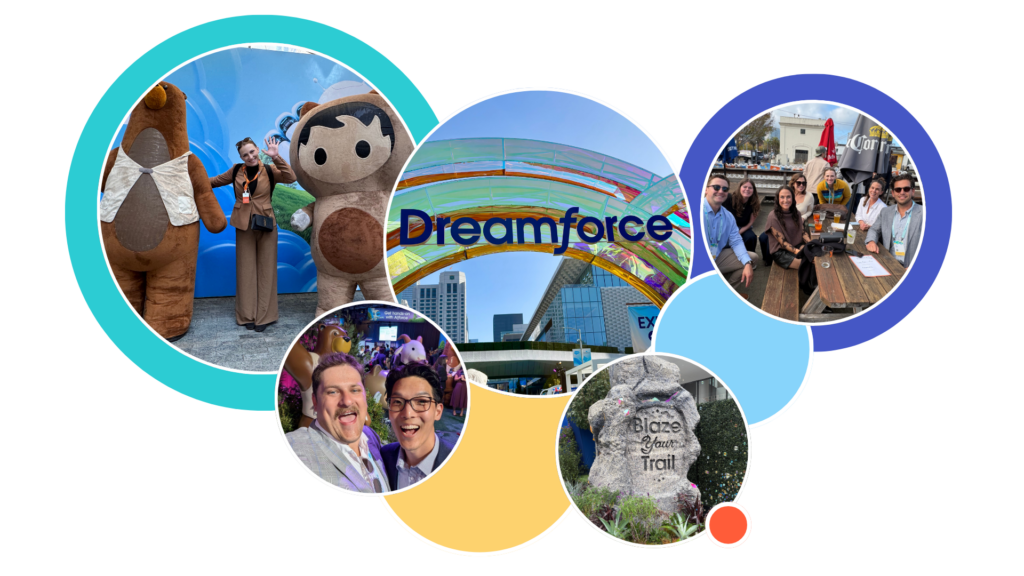
Dreamforce itself reflected that evolution this year. Conversations weren’t limited to what agents can do. Sessions increasingly focused on grounding them in enterprise context, governing their behaviour, integrating them across systems, and tying AI investment back to business value.
That’s a meaningful shift.
The technology is getting more capable. The consulting challenge is increasingly about where and how to apply that capability well. And you get much better at answering that question when you’re listening to more than one side of the ecosystem.
Put the Angles Together and the Read Gets Sharper
Some of the most useful Dreamforce conversations didn’t happen on a stage. They happen when a customer explained why a seemingly straightforward initiative became complicated. Or when a Salesforce seller shared the objection they’re suddenly hearing repeatedly. Or when an architect pointed out the dependency everyone else skipped over. And when two people from completely different industries realize they’re wrestling with essentially the same operational problem.
Those conversations create signals.
One conversation is an anecdote. When you hear the same challenge from a customer, then an AE, then an architect, then another company in an entirely different vertical, it starts to become a pattern.
That’s where a point of view becomes more valuable. Not because everyone agrees, but because the idea has been pressure-tested from multiple directions. And we saw plenty of that around the agentic AI conversation this year.
The conversation is becoming less about proving that agents can perform meaningful work and more about figuring out how to make that work reliable, governed, connected, and economically worthwhile inside real businesses.
Those aren’t questions a demo can answer on its own.
They’re answered through implementation experience, customer feedback, architectural constraints, failed experiments, multiple POCs, successful use cases, business outcomes, and a lot of conversations between people who see different pieces of the puzzle.
No single vantage point gets you there. A room full of them, comparing notes, does. Put enough of those perspectives together, and the picture gets sharper.
Relationships Are Part of the Architecture, Too
There’s another side of Dreamforce that’s easy to dismiss as simply “networking.”
We don’t think it is.
Consulting depends on understanding context, and context comes from people. The better we understand what customers are being asked to deliver internally, what Salesforce teams are hearing in the field, where architects are seeing complexity emerge, and what leaders are prioritizing next, the better equipped we are to give useful advice.
That doesn’t happen by collecting business cards. It happens by building relationships where people are willing to tell you what’s actually happening: what’s working, what’s frustrating them, what’s getting budget, what’s getting blocked, and what problem they’re really trying to solve underneath the technology request.
That understanding becomes part of the work. Because ultimately, we’re not implementing technology into a vacuum. We’re helping businesses change how people sell, serve customers, make decisions, manage data, and operate.
The technology matters enormously. So does understanding the people using it.
It’s How We Build Our Own Point of View
That brings us back to why Dreamforce continues to matter to us.
The scale compresses something we spend the rest of the year doing into a few very busy days: listening across the ecosystem.
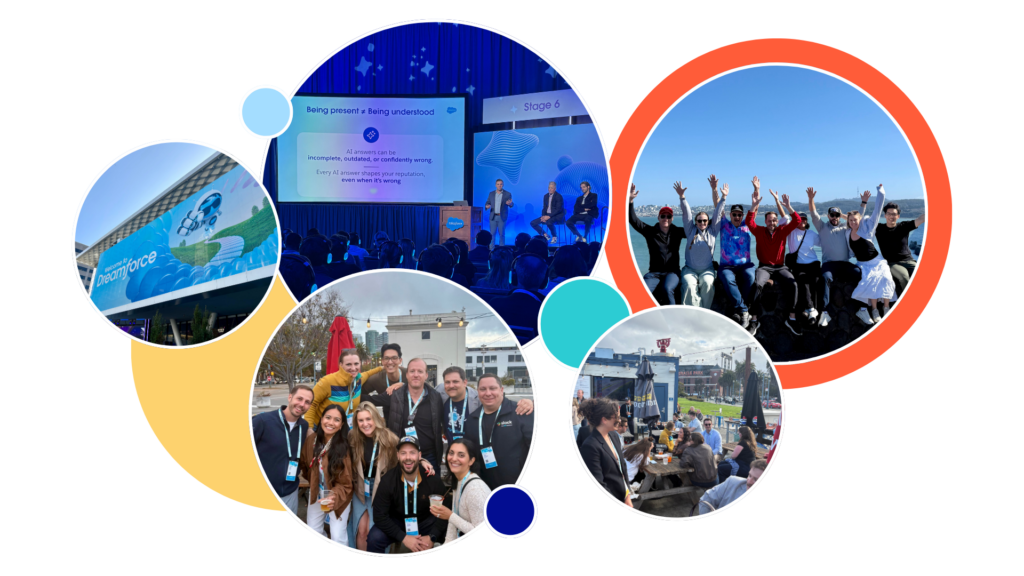
At Lane Four, we’re inside GTM and RevOps environments at different stages of maturity, across different industries, business models, technology stacks, and use cases. No single engagement tells us what’s true. No single product roadmap does either. We build our point of view from the patterns that survive across all of them.
What keeps coming up? Where are companies getting stuck? Which architectural decisions create flexibility later? Which seemingly exciting use cases struggle to produce value? Where are the capabilities finally catching up to problems businesses have been trying to solve for years?
Those patterns shape the recommendations we make.
And Dreamforce is one of the rare opportunities to pressure-test them against an enormous cross-section of the ecosystem at once.
So yes, we came home with plenty to unpack from Dreamforce 2026. Our architects will dig deeper into the technical announcements, and there will inevitably be individual capabilities worth exploring in much more detail. But the bigger takeaway is simpler.
The value of knowing what’s new comes from understanding what to do with it.
And that understanding gets stronger when you listen broadly; to the people building the technology, selling it, implementing it, operating it, and living with the outcomes.
That’s what Dreamforce puts in one room. And it’s the perspective we try to bring back with us. If you’re working through what the latest shift in Salesforce, AI, or your broader GTM technology stack actually means for your business, that’s usually where we’d rather start the conversation…not with what can we implement?, but what are you trying to change?
Let's chat!