There’s a moment, usually early in the morning before the calendar fills up, where things are quiet. No Slack pings. No client calls. Just a calm stretch of time and a chance to think.
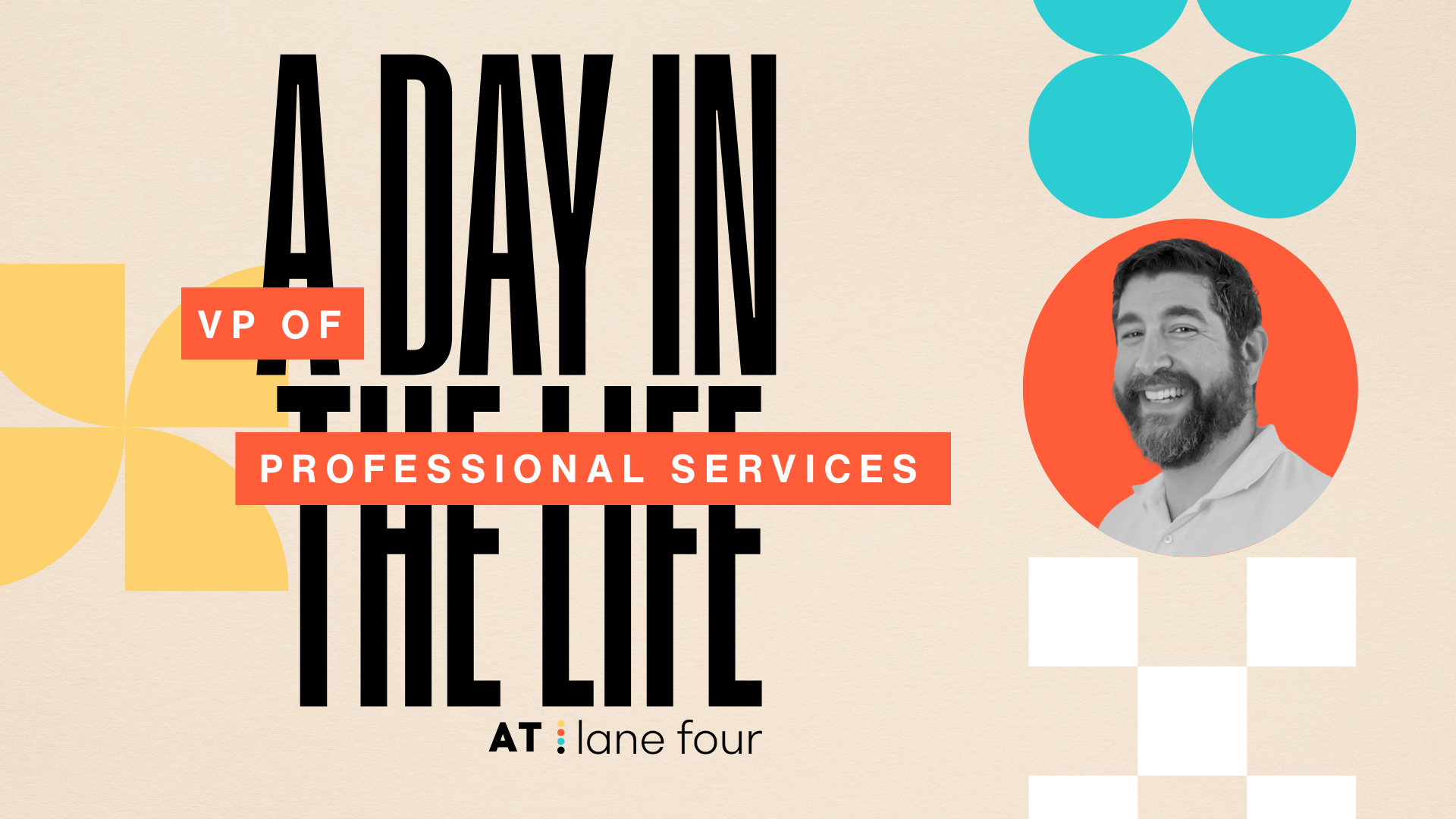
For Michael Strong, that window matters more than most people would guess. Because once the day starts, it moves fast.
From diagnosing complex revenue engines to guiding teams across delivery, strategy, and emerging AI capabilities, Mike’s role as VP of Professional Services sits at the center of Lane Four’s consulting model.
We sat down with Mike to unpack how he got here, what his day actually looks like, and how he’s thinking about the future of RevOps in a world that’s changing faster than most organizations can keep up with.
Q: You’ve built your career at the intersection of consulting delivery and revenue operations. How did that journey take shape, and what drew you into this space in the first place?
Mike: “I’ve always had an affinity for metrics, even before I knew there was a career built around them.
Early on, I was working at a startup in what was essentially a deal desk function, though we didn’t call it that at the time. We had access to data, but no real way to make sense of it. So I started building my own dashboards in Excel. Spreadsheets, charts, whatever I needed to track what I was doing and understand what made a deal successful.
That curiosity kind of snowballed. I moved from tracking deals to tracking broader sales performance, and along the way I had some really strong mentors who nudged me toward operations.
What clicked for me was realizing that RevOps is really about making sense of the business through numbers, but also translating that into something actionable. It sits in the middle of sales, marketing, and technology, and you have to be able to speak all three languages.
My background helped with that. I studied English in undergrad, so communication has always been a strength. Then I went back for my MBA, which gave me a stronger foundation in how these functions actually fit together inside a business.
If you combine that with a comfort in technology, especially understanding systems at a foundational level, it becomes a really natural fit.
Honestly, a lot of that started with Excel. When you understand how a spreadsheet works, multiple tabs, relationships, structure, you’re basically understanding a mini database. That thinking translates directly into how modern systems are built.”
Q: As VP of Professional Services, what does your role actually look like day-to-day, and how do you balance delivery excellence with broader strategic oversight?
Mike: “It’s varied, and “varied” is probably underselling it. At a high level, I think about my role in a few core buckets. The first is delivery. At the end of the day, we’re a consulting firm, so being in front of clients, understanding their problems, and helping shape solutions is critical. I’d say about half my time is still client-facing, especially in early-stage conversations where we’re diagnosing challenges and translating them into something the delivery team can execute on.
Then there’s team leadership. I oversee delivery, project management, and our Foursight function. That means making sure teams have what they need, navigating staffing, supporting managers, and stepping in when things get complicated, which they inevitably do.
There’s also a strategic layer. How do we grow these functions? How do we evolve our go-to-market approach? How do we stay ahead of technology shifts, especially with AI changing so much so quickly?
And then there’s the reality of administration, resourcing, alignment across teams. All the connective tissue that keeps the organization functioning.
The truth is, all of that adds up to more than 100%. Some days are heavier on people, some on projects, some on strategy. But there’s always a delivery component.
One thing I’ve been focused on lately is building more resilience within the team. Early in your career, you tend to jump into everything. As you grow, it becomes more about enabling others to solve problems without needing to step in every time.
I sometimes think of it as extending my reach through the hands of those on my team. The goal [at the end of the day] isn’t necessarily doing the work myself, but ensuring everything is moving in the right direction.”
Q: When you step into a client environment, what are the first signals you look for to assess whether a revenue engine is truly healthy?
Mike: “I usually start with conversations, not dashboards. I want to understand how people actually do their jobs. What steps do they take? Where do they go to find information? Who do they rely on?
If something is working well, it tends to be simple. “I update this field, I click a button, and I’m done.” But that’s not what we usually see. More often, it’s a series of workarounds. “I pull data from this spreadsheet, then I talk to this person, then I update something over here.” And that’s where the friction shows up.
I like to break processes down because they reveal a lot. You start to see where things are fragmented, where data is unreliable, and where teams are compensating for system gaps.
Another big signal is the presence of spreadsheets everywhere. Spreadsheets are incredibly powerful (as I’ve stated previously); they can do almost anything. But when they’re running your sales process, it usually means there’s a gap in your core systems. That’s where the opportunity is.
I also approach it from both directions. Bottom-up, understanding how people work day-to-day. And top-down, talking to leadership about what’s slowing them down. When those two perspectives align, the current issues start to become very clear.”
Q: You’ve likely seen both ends of the spectrum: organizations with no RevOps structure and those with teams that aren’t fully aligned yet. Which scenario do you encounter more often today?
Mike: “The most common scenario isn’t either extreme. But moreso, it’s one person trying to do everything.
Usually, it’s a very capable RevOps professional who’s acting as the bridge between people, process, and technology, and across multiple revenue functions. But they’re stretched thin. They’re handling strategic work and administrative tasks at the same time, which means they’re constantly behind.
A lot of their time gets consumed by repetitive, low-value tasks. Moving fields, reassigning accounts, fixing data issues. Things that need to happen, but don’t actually move the business forward.
That’s where I think AI, especially agentic use cases, becomes really interesting. If you can offload those repetitive tasks, you free that person up to focus on higher-value work. Strategy, stakeholder alignment, system design. The things humans are actually good at. At a high level, that’s what good AI implementation should do. Improve internal efficiency while also improving the experience for customers.
If you can achieve both, you’re in a very strong position.”
Q: What does a “great” consulting engagement look like from your perspective?
Mike: “It starts with understanding the business, not the technology. I think a common mistake is starting with tools. “You need this stack, you need this platform.” But technology should be an expression of the solution, not the starting point.
We spend a lot of time understanding goals. What does success actually look like for the business? What problems are they trying to solve? From there, we work backward. What processes need to exist? What does each stage of the customer journey look like? How should teams interact?
Only after that do we get into technology.
When it works well, the result isn’t just a better system. It’s a team that can operate with less friction. They understand what they’re doing, why they’re doing it, and how everything connects.
That’s success to me. Not just delivering a solution, but changing how the team functions.”
Q: What’s one part of your day that might surprise someone outside of consulting?
Mike: “I block time every morning to think and get the rest of my day (or week) set up. It sounds simple, but it’s probably one of the most important parts of my day.
Most of my daily schedule consists of back-to-back meetings. If I don’t create space to step back, organize my thoughts, and plan, it’s very hard to operate at a high level.
That quiet time is where I can be intentional. It’s where I can prepare for conversations, think through problems, and make sure I’m not just reacting all day.
I try to protect it as much as possible.”
Q: How do you ensure alignment across Sales, Marketing, and Customer Success when each team is operating with different priorities?
Mike: “A lot of it comes down to reframing the problem. Silos usually exist because teams are focused on their own challenges. But when you look closely, many of those challenges are shared. Data quality, handoff issues, unclear definitions; those problems don’t belong to just one team.
So instead of presenting isolated solutions, we focus on the full revenue funnel. How everything connects. Where dependencies exist. When you show teams that they’re actually solving the same problem from different angles, alignment becomes easier.
It’s less about forcing collaboration and more about revealing it.
That said, it’s not always smooth. There are cases where people resist change. Sometimes it’s comfort with the status quo. Sometimes it’s concern about what change implies.
Part of our job is navigating that. Understanding the dynamics, working with leadership, and helping teams move forward in a way that feels constructive, as opposed to disruptive.”
Q: The pace of change in this space is intense, especially with the surge of AI. How are you thinking about keeping your team and clients ahead of the curve?
Mike: “It’s challenging. The pace right now is faster than anything I’ve seen.
We lean heavily on our architecture team to stay close to new capabilities. They’re constantly testing, demoing, and exploring what’s possible.
At the same time, we’re thinking at an executive level about how these technologies actually change the way businesses operate. The reality is, what we recommend today might be different six months from now. That’s just the nature of the space.
So part of it is being transparent with clients. This is evolving. Flexibility matters. But there’s also a huge upside. The rate of innovation isn’t linear, it’s accelerating. More people are using these tools, more ideas are being generated, and that creates real opportunity.
Our job is to help both our internal team as well as clients navigate that without getting overwhelmed.”
Q: As someone who’s been in the space for some time, if you had to give two pieces of advice, one to a GTM leader and one to someone early in their career, what would you say?
Mike: “For GTM leaders: simplify.
There’s a tendency to over-engineer systems in pursuit of perfection. But getting from 80% to 100% often requires more effort than getting from 0% to 80%. And in many cases, that extra effort doesn’t create proportional value.
Focus on the broad use cases. Build something that works well enough to support growth, and iterate and expand from there.
For someone early in their career: understand what you’re doing before you try to automate it.
AI is powerful, but it can create a surface-level understanding if you rely on it too much, too early. You get outputs without fully understanding the inputs.
Start manual and don’t be afraid to get your hands dirty. Build things yourself. Learn how systems actually work. Then layer in automation.
That foundation matters more than anything else.”
There’s no clean, linear path through consulting. No perfectly structured day. No static playbook that holds up for long.
And maybe that’s the point.
What stands out in Mike’s approach isn’t just technical depth or strategic thinking, though both are clearly there. It’s the way he, as well as all of our leaders, navigate complexity without overcomplicating it. The focus on people before platforms. On clarity before optimization.
Because in the end, the goal isn’t just better systems. It’s creating better ways of working.
Are you ready to
unleash your future?
Let's chat!