
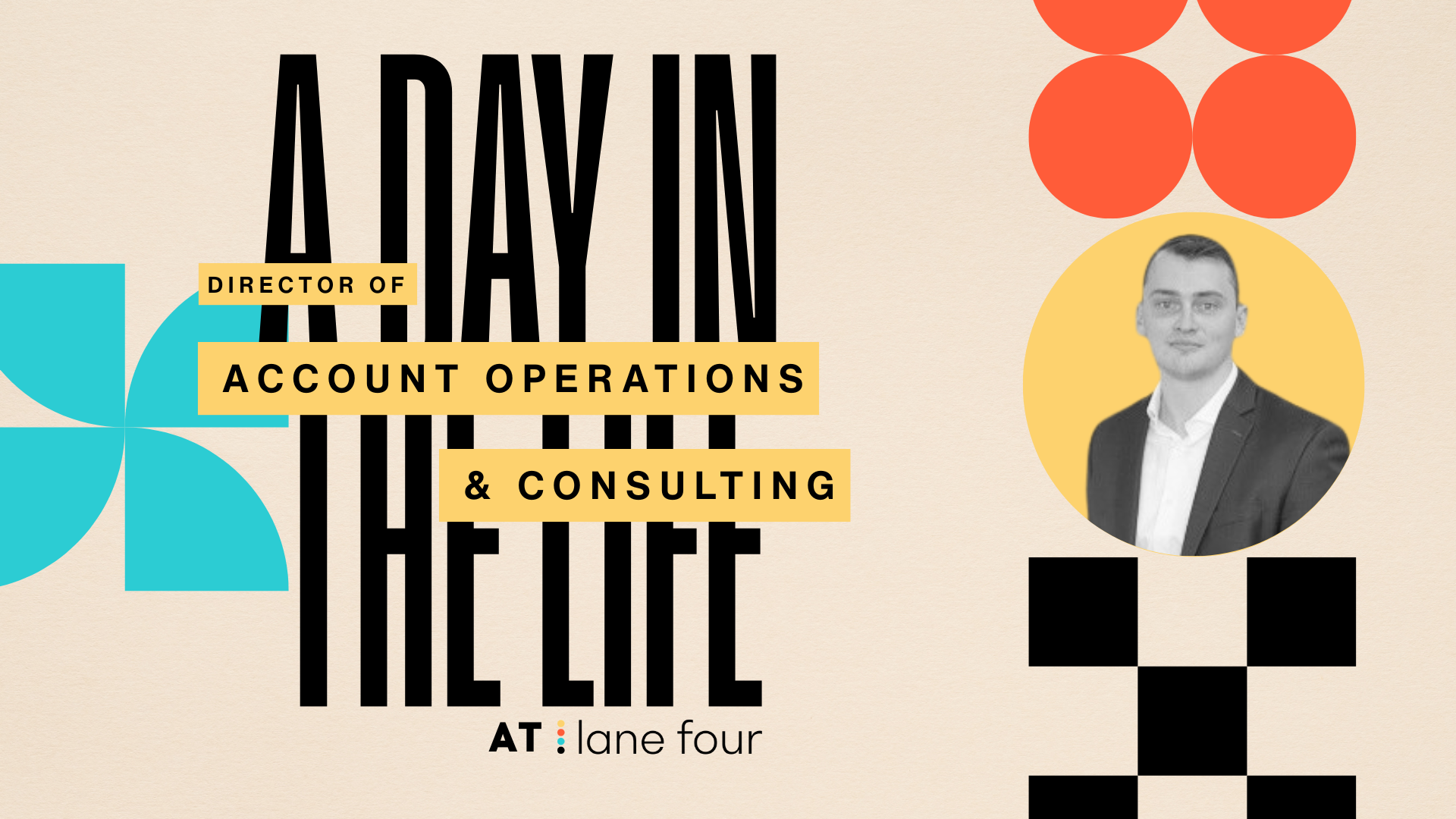
Account stewardship at Lane Four isn’t a checklist…and it’s definitely not a single meeting. It’s a discipline. One that shapes how we build strategy, staff teams, and deliver outcomes that actually stick.
At the core of that discipline is trust; earned through consistent communication, thoughtful problem-solving, and results you can point to. Our work lives at the intersection of strategic account leadership and people-first delivery: putting the right skills on the right problems, coaching teams to think beyond the task in front of them, and treating every client relationship as a long-term partnership worth protecting.
Leading that work day-to-day is no small thing. We sat down with Aldus Behan, Director of Accounts Operations and Consulting, to find out what that actually looks like in practice — how he balances strategy with execution, navigates staffing decisions, and keeps Lane Four’s values at the center of both client work and team development.
Q: If someone followed you around for a day, what might surprise them about your role?
Aldus: “I think most people would be surprised by how much of my role is about problem solving. It’s not just managing accounts or checking off tasks. A lot of what I do is identifying how we can create win-win solutions for both our clients and internally for our teams. That includes making sure we have the right people on the right projects, coaching team leads, and thinking through staffing decisions.
Some might assume my role is mostly about sales or technical delivery, but really, it’s about breaking problems down and figuring out how to best set our teams and our clients up for success. It’s a mix of account strategy, people management, and consulting, all coming together in ways that often aren’t visible on the surface.”
Q: Can you walk us through your responsibilities as Director of Accounts?
Aldus: “My role is multifaceted. I manage three delivery teams, each led by a manager or technical lead, and make sure our teams are delivering high-quality work while feeling supported and coached. At the same time, I oversee client accounts in partnership with those team leads, keeping an eye on client relationships, engagement, and overall account health.
When there’s an opportunity to grow within an account, I help lead those conversations, from exploring potential solutions to drafting agreements. My days are part delivery, part account management, and part sales strategy. Balancing these moving parts is what ensures our internal capacity stays aligned with our clients’ long-term growth objectives.”
Q: How do you define a healthy account, and what signals do you watch for over time?
Aldus: “A healthy account is one where we are engaging consistently. Regular communication is key. We want to hear from our clients and we want them to feel comfortable talking with us. Beyond just talking, a healthy account is one where we are driving meaningful progress. It’s not about ticking boxes. It’s about moving the needle for their business and achieving outcomes that matter to them.
Strong relationships, consistent engagement, and accountability in delivering quality work are the three pillars I use to assess account health. When all three are present, we move beyond a vendor-client relationship and become a core extension of their team.”
Q: What strategies help accounts continue to grow rather than plateau or churn?
Aldus: “We rely on regular check-ins, such as quarterly business reviews. These give us a chance to step back from day-to-day tasks and look at the bigger picture. We review successes, highlight recent wins, and identify opportunities where we can provide additional value.
Importantly, we also listen. Understanding what clients are aiming to achieve next (for the business) allows us to align our work with their evolving objectives. These conversations are not just about sharing what we have done. They are about planning the future together. That approach helps drive account growth and keeps clients engaged.”
Q: How do you train and enable consultants to build strong client relationships?
Aldus: “We train our consultants to lead with a perspective rather than just reacting to a queue. The goal is to solve for the ‘forest’ not just the ‘trees’ This means moving past the face-value request to understand the underlying business driver. If a client asks for a tactical fix, our team is enabled to step back and assess if that change actually protects long-term momentum or if it creates technical debt.
Because we work across such a high volume of GTM environments, we bring a unique vantage point to every call. We don’t just execute tasks; we act as an advisory extension of their team. By identifying early signals that a request might miss the broader objective, we can offer alternative approaches that drive measurable outcomes and turn a standard engagement into a strategic expansion.”
Q: How do you coach team members to think strategically across accounts?
Aldus: “We coach our team to lead with a systemic view of the client’s business. This starts by mapping how our immediate work impacts the broader GTM engine. If a consultant is optimizing a sales tool but identifies a downstream friction point for marketing, they are trained to pause and connect those dots rather than delivering in a silo.
We treat strategic thinking as an operational skill that requires repetition and exposure. Recently, we’ve leaned into consultative exercises to help the team pressure-test requests before they reach the execution phase. This deliberate ‘slow down’ allows us to pivot from tactical tasks to high-impact recommendations. It is a continuous feedback loop: we are constantly honing the ability to identify where a single technical change can drive a scalable outcome across the entire account. We aren’t just looking for quick wins; we are solving for a more cohesive and durable environment for our clients.”
Q: When do you see risk in an account, and how do you respond?
Aldus: “Risk shows up as a loss of momentum. The most telltale signal is a drop in engagement. When clients start rescheduling syncs or pulling back on their time investment, it is a leading indicator of a disconnect. If a client stops investing time, it usually means our work is no longer mapping to their high-priority outcomes.
Our response is to immediately pause and diagnose the friction point. We look at whether we are missing the mark on delivery, if there is a communication gap, or if their internal strategy has shifted. We do not let these discrepancies linger. We reconcile them by realigning our roadmap to their current business drivers. Identifying these signals early allows us to course-correct and protect the health of the partnership before a small gap becomes a stalled engine.”
Q: How do you collaborate with other leaders to ensure long-term success for accounts?
Aldus: “We treat account success as a cross-functional discipline. I work closely with our delivery leads and technical managers, who really act as the tip of the spear. That partnership is what ensures our day-to-day execution stays mapped to the client’s broader GTM strategy. It’s about keeping the high-velocity delivery on track without losing sight of the long-term roadmap.
We also bring in our architecture group early to help flag technical debt before it turns into a bottleneck for growth. By looping in that technical leadership, we can provide the proactive points of view needed to keep a client’s environment durable as they scale. Finally, we coordinate with our marketing and operations teams to quantify that impact through CSAT and performance data. It ensures our value isn’t just something the client feels, but something we can actually measure and repeat across the business.”
Q: Which Lane Four values resonate most in your role, and how do they show up in your work?
Aldus: “Being human and doing good work are the two that stand out for me. Being human is about leading with empathy and authenticity. We aren’t just executing a backlog of tasks; we are building relationships and acting as an extension of our clients’ teams. When you create an environment where the team and the client actually have fun together, it breaks down the typical vendor-client friction and builds the kind of trust that allows us to have more honest, strategic conversations.
That human connection is what makes the ‘doing good work’ part possible. Delivering quality outcomes ensures our clients trust our recommendations and want to continue the partnership. When those two values are in sync, it transforms the engagement. Instead of just checking off deliverables, we are solving problems alongside people we respect.”
Q: What advice would you give to professionals entering revenue operations or looking to improve account management?
Aldus: “For those new to revenue operations, start by understanding the why behind processes. Learn how sales, marketing, and customer success connect and what a client journey looks like from start to finish. Technical skills are important, but the foundation is understanding the process and importance of alignment.
For improving account relationships, curiosity and authenticity are key. Ask questions, listen actively, and establish trust. Focus on understanding what matters to your clients, and then use that insight to make a meaningful impact. When clients see you are invested and genuinely care, relationships thrive.”
Aldus’ approach defines account operations at Lane Four: a discipline grounded in technical trust, proactive problem-solving, and a human-first mindset. His focus on mapping tactical execution to a broader GTM strategy ensures that we aren’t just delivering tasks, but building durable environments where our clients can scale with confidence.
For our partners, this means an account team that anticipates friction before it impacts momentum. For our consultants, it creates a culture of continuous development where strategic thinking is an operational standard.
If you’re looking for a partner to help navigate your next phase of growth, let’s chat about how our account operations team can move the needle for your business.