
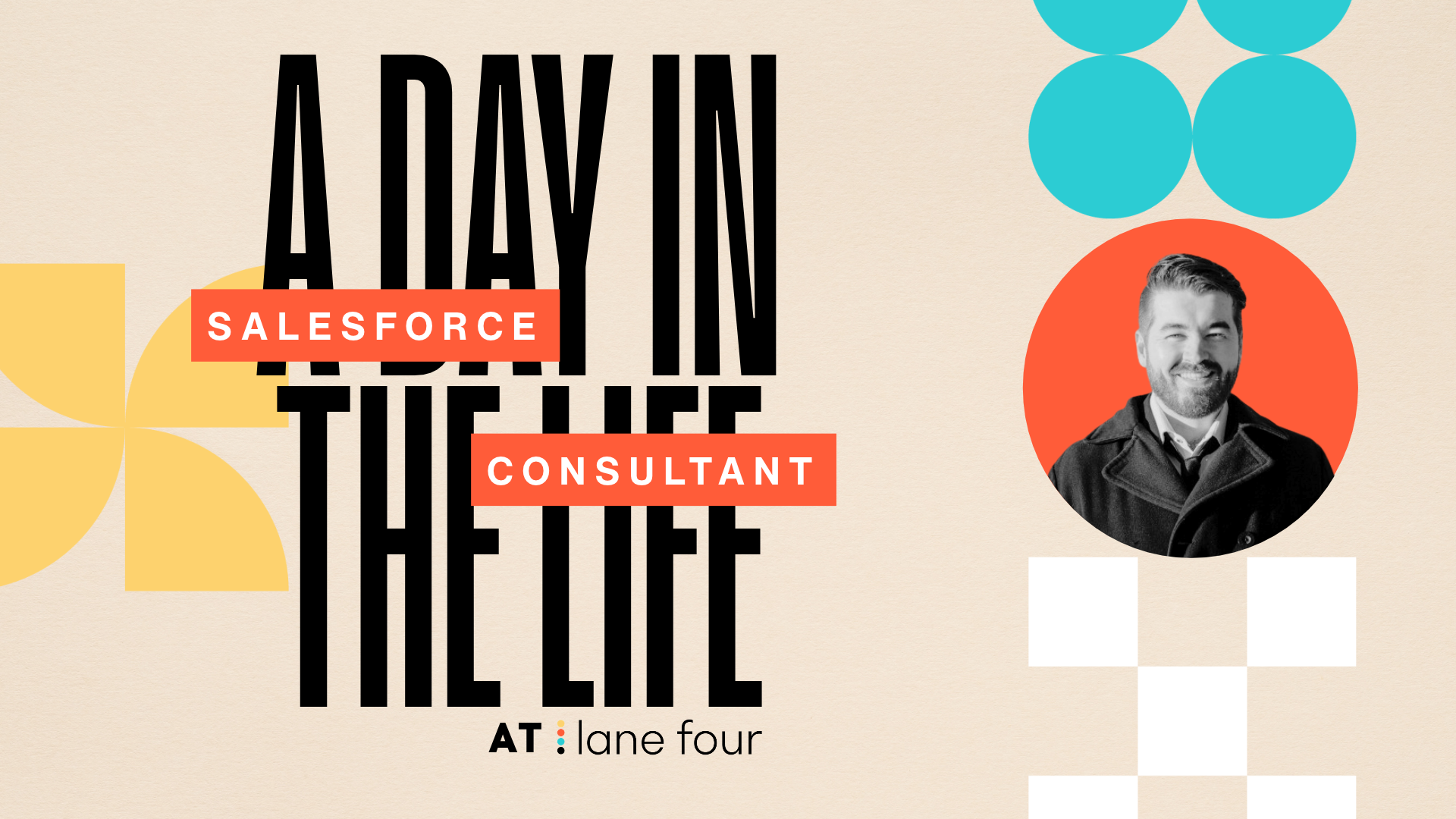
Ben Lee has always believed people should be doing creative work, not manual data entry. It’s what pushed him to teach himself Python to escape a tedious process in advertising, and it’s what makes him the kind of consultant who asks to really see the problem before he tries to solve it. When a client says something is broken, Ben is the one eager to get his hands on the screenshots, examples, and the full story as soon as he can.
As a Salesforce Consultant at Lane Four, Ben builds the Salesforce automations that take repetitive work off our clients’ plates and makes sure their teams are ready to use what gets built.
We sat down with him to talk about his path from video production to Salesforce, and how that instinct shapes his work.
What first drew you to Salesforce, and what led you to the consulting side here at Lane Four?
Ben Lee: “I’ve always loved technology, and I’ve always been an automation enthusiast. A lifetime ago, my early career was in videography and media, and even then, my favourite part was figuring out the best workflow for something like a multicam setup.
When I moved into advertising, I ended up handling a lot of data processing. A big part of the job was making slates; the graphics that show up before an ad plays. The process was rough. You’d get what were essentially handwritten notes packed with information, then build everything manually in Photoshop as quickly as possible without making a single mistake. I figured there had to be an easier way, so I taught myself Python to automate it. It made my life so much easier, and I was so much happier at work.
I was telling Mike Scott, a friend who also works here at Lane Four about it, and he told me about Salesforce. He explained that it’s a great platform for doing exactly that kind of work for other people: taking repetitive tasks off their plates, automating them, and solving more challenging problems along the way for a business. That really stuck with me, because I believe people should be doing creative work, not drudgery like manual data entry (although I do understand the importance of tasks like those still).
He’s always let me know about the coolest opportunities, and that’s what brought me to Lane Four specifically. I’ve really enjoyed consulting since. So much of it is helping people take information from bucket A, move it to bucket B, do something interesting with it, and save their teams a ton of manual work along the way.”
What’s something about being a Salesforce consultant that people might not expect?
Ben Lee: “You need to be a bit of a detective. Someone might come to you and say process X is broken, but you can’t take everything at face value. You go back and ask: Why do you say it’s broken? Can you show me screenshots? What are you expecting it to do? What other tasks is this now blocking?
A lot of the time, issues come in misdiagnosed. Technical people love to see a problem and immediately go hunting for the cause, without realizing it was misstated in the first place, and you can waste a lot of time that way. I was definitely guilty of it on my first couple of projects, trying to solve a problem that turned out not to exist. That’s part of the learning process, but it’s an important lesson.
I think one of the biggest things that separates someone who is just starting out from someone who’s been around the block a few times is figuring out what the problem actually is, and confirming it, before spending hours solving it. If you’re talking more than 50% of the time on a discovery call, you’re doing something wrong. Your job is mostly to say, ‘Tell me more about that. Show me your process and what you need done.’”
No two weeks in consulting look quite the same. Can you walk us through a typical week, and what kind of work gives you the most energy?
Ben Lee: “There’s a lot going on week-to-week, but there are a few staples. At the start of the week, I meet with my team. We plan where our time goes across clients that week. It’s important to check in every week on which clients have a launch coming up and might need more attention, and which might be away and need us to scale back for a week or two.
From there, I block out my time around my client calls, so I’ve got some hours ahead of each call and some after for follow-ups. Then it’s heads down on the build, plus regular client meetings to make sure everything is on track. I’ve started using a standardized agenda with more and more of my clients: what I’ve done, what’s in progress, what the priority list looks like, and then a good amount of time for what’s new with them and any new issues they’re running into.
I also try to come into the office twice a week for lunch. Sitting around a table with other consultants who are working on challenges you might haven’t run into (yet) yourself is one of the best parts of being at a consultancy this size. You learn so much from that community.
What gives me the most energy is solving a technical issue, especially a unique one. Someone brings you something, you’ve got an idea of how it might work but you’re not sure, and then you pull it off and it makes a real difference for their team. Bonus points if the client loves the solution and it really makes a positive impact in their business. That’s the part that makes me happiest.”
Take us back to a project where it took some real digging and creative approaches to get to a solution. What did it take to get to the root of it? What was the outcome?
Ben Lee: “Some of the most frustrating problems in tech are email problems: an email not sending, landing in spam, or getting rejected by a filter. On one project, whenever a user went to email a customer from Salesforce, the ‘To’ field would sometimes fill in with the user’s own address instead of the customer’s. It only happened every couple of weeks, which made it really hard to pin down.
So I asked the client to send me an example every time it happened, and I logged each one in a ticket. Over a few weeks, a pattern showed up. It was always on a particular type of case created through an automated flow. When those cases were created, the attached email was being tagged as Outgoing instead of Incoming, so Salesforce’s out-of-the-box functionality was treating it as a sent message and swapping the ‘To’ and ‘From’ addresses.
The fix was the simplest thing afterall: checking a single checkbox in a flow. Getting there took the longest time, though, because it was all about gathering enough data to see what was really going on. It was a tiny change with a real impact. The team had been sending emails to themselves instead of their clients without realizing it, and when something that small is quietly breaking customer communication, you have to be willing to dig for it.”
Can you think of a time you recommended a different direction than the client had in mind? How did you work through that conversation?
Ben Lee: “A client once asked whether they could change a trigger condition in one of their flow automations. At the end of the day, it’s their system, and they should be able to make changes to it. We’re there to support them. But when someone asks whether a change matters, I never want to just say, ‘Yeah, it’s probably fine,’ or ‘Don’t do that.’ I want to do my due diligence.
So before answering, I went into the automation and tested what would happen if they made that change. It turned out it would fire far too often and essentially break the automation. I let them know, and then I asked why they wanted to make the change, because a lot of the time there’s something hidden behind a request; some other condition you’re not aware of.
In this case, they really just wanted to understand how it worked, which is a perfectly valid reason, and they kept it the way we’d built it. Sometimes your role is simply to inform. When a client suggests a different direction, take it seriously, give it real consideration, and tell them what you think will happen. From there, the decision is theirs. Our job is to make sure it’s an informed one.”
A solution only makes an impact if the team uses it. How do you make sure clients feel confident with what you’ve built once the project wraps?
Ben Lee: “That feeling of confidence is really the goal of the whole engagement; even more than any particular technical solution. Tangible results matter, of course, but the client walking away confident they got what they needed is probably the most important thing we can give them. And you can’t treat it as an afterthought in the last quarter of the project. You have to plan for it from the start.
A big part of that is making sure clients know their decisions are shaping the work throughout, not just at the beginning (or even nearing the end). That means checking in every week or two, whatever the cadence is, and demoing regularly: Here’s the process we talked about. Here’s how it’s working. Is this still what you had in mind? Build, demo, iterate. Often it’s only once they see it that they realize they wanted users to interact with it differently, and that’s exactly when you want to find out.
Reporting helps too. For one client, we set up messaging, and giving them reports on things like the number of messaging sessions and the average session length showed them their team was actually using the process we’d spent months building together.
But if I had to pick one thing, it would be building a good UAT process in from the get-go. For example, planning for three months of build and then two months for the client’s team to test. There are always bugs and edge cases no one can predict, and you want users to get access as early as possible so they can work with it and provide feedback. People will be averse to something if they’re already very familiar with the former process and are suddenly handed a new one they don’t actually understand.”
What’s a small change you made for a client that ended up having a larger impact than you expected?
Ben Lee: “One of the funniest things about Salesforce consulting is that you can spend 100 hours building a beautiful data model with clean flows, Apex, and triggers all set up properly, the whole thing perfectly orchestrated, and the reaction is polite. Then you do something simple like change a page layout and it blows their mind.
A colleague taught me this one. The page layout is what clients see every day, so a thoughtful change there moves the needle far more than any behind-the-scenes optimization. Now, anytime I build a really nice automation, I update the page layout to reflect it, so users can see the value of the work underneath. The response is better every time. People love good UI.”
Who do you work most closely with day to day, and what does it look like when you need a second set of eyes on something?
Ben Lee: “Right now, I’m working most closely with one other consultant on my team. We have a daily scrum at 9:30 where we block out our time and go through what we did yesterday, what we’re doing today, and what’s blocking us. Because that check-in is built into our day, getting a second set of eyes is easy. If something’s blocking me, I raise it on the call, ask if they can take a look, and it’s out of the way sooner than later.”
What makes Lane Four a different place to do this work; both for the clients you support and for you as a consultant?
Ben Lee: “The collaborative atmosphere and proximity to stellar coworkers has been a big part of why I’ve enjoyed working at Lane Four. I can come into the office and sit next to people with a lot more experience than I have. I can ask a colleague whether they’ve worked with connected apps or external client apps, and they’ll tell me all about them. It works the other way too. A more junior teammate might be studying for a certification on something newer like Agentforce or Revenue Cloud, and you pick things up from them directly. That back-and-forth between consultants, at every level, is really valuable.
For clients, I think Lane Four is unique in that we’re genuinely flexible on things like meeting cadence and hours when it’s meaningful to the client and will yield positive return later. If a main stakeholder is going on vacation for two weeks and would rather we scale back while they’re away, we can talk about it as a team, adjust our hours, and adapt to what they need in that moment. Being able to remain lean and agile with our clients like that is something I really value about Lane Four.”
How has Lane Four supported your growth, whether through certifications, mentorship or new kinds of projects?
Ben Lee: “Lane Four truly supports dedicated professional development initiatives, and it’s made a big difference for me. I’ve picked up six certifications since I’ve been here, and having that support matters, because certifications can be costly; in time and money.
The people are a big part of it too. Everyone knows a bit about the general side of Salesforce, like Sales Cloud, but for specific pockets like Revenue Cloud or Marketing Cloud Account Engagement, you want to talk to someone who’s been working in it for a year or more. Being able to say, ‘Can you help unblock me?’ and have someone answer, ‘I do this literally every day,’ gets you moving again fast.
Then there’s the variety of projects. Lane Four is really good about putting you on a project where you’re still building experience, or one you’re interested in. In an in-house role, you can spend years working in the same two pieces of Salesforce. In consulting, you hop onto a new client, see how they’ve set things up differently than you’d expect, meet new people, build a network in the tech world, and continuously repeat and grow. That versatility has taught me a lot.”
Which Lane Four value do you find yourself leaning on most in your day-to-day work, and why?
Ben Lee: “Own it and do good work. That one just feels right to me. There’s nothing more satisfying than taking on a challenge, seeing it through, and delivering real value to the people who are looking to you for support. That’s the best feeling in the world.”
For someone with a few years of Salesforce experience who’s thinking about moving into Salesforce consulting, what advice would you give them?
Ben Lee: “If you’re interested, do it. Just know what you’re getting into. Consulting moves at a faster pace than an in-house role at a single company. You’ll meet a lot more people week over week, and you’ll regularly run into technology you’ve never heard of, then two weeks later need to integrate it with another piece of technology you’ve also never heard of.
So being adaptable and willing to learn is really important. It’s part of the job. There’s a bit more pressure too, since you’re delivering within set timelines and budgets. It can be more demanding, but it’s also more fun.”
Ben’s path into Salesforce didn’t start with the platform. It started with a pile of handwritten notes, a tight turnaround, and the belief that people shouldn’t be stuck doing work a system could do for them. That same instinct runs through how he consults today: confirm the real problem before solving it, test before giving an answer, and build adoption into the plan from day one rather than hoping for it at the end.
It’s also a reminder of what good consulting looks like at Lane Four. Whether he’s tracking down a bug that only surfaces every few weeks, building real user testing into the plan from the start, or updating a page layout so users can see the value of the work underneath, Ben keeps the people who use the system at the centre of every build.
Want a Salesforce team that digs into the real problem before building the solution, and makes sure your people actually use what gets built? Let’s chat.
Let's chat!
